








Heroin hasn’t disappeared, but the way it shows up in the opioid crisis has changed. Over the last few years, national data show heroin-involved overdose deaths continuing to decline, while synthetic opioids like fentanyl, nitazenes, and veterinary sedatives dominate the landscape. Signs of a heroin overdose look similar to other opioid overdoses and include slowed or shallow breathing, loss of consciousness, and blue/purple fingernails and lips.
The shift has changed how treatment providers think about heroin and opioid use disorder—less as a single-drug problem and more as a moving target shaped by an unpredictable illicit supply. People may move between prescription opioids, heroin, fentanyl, or stimulant-opioid combinations depending on availability and cost [1].
Nonetheless, heroin remains a serious and potentially deadly drug, and many warning signs are subtle long before a crisis occurs. Recognizing early behavioral and physical changes and knowing when someone needs immediate help can prevent a fatal overdose.
What Is Heroin, and How Does It Affect the Brain?
Heroin is an opioid made from morphine, extracted from the seeds of the poppy plant. It’s a depressant, meaning it slows activity in the central nervous system. People may encounter it as a white or brown powder or as a dark, sticky form called black tar heroin.
After it enters the body, heroin very quickly binds to opioid receptors throughout the brain and spinal cord. Those receptors normally help regulate pain, stress, and basic survival functions, including breathing. It can produce a rush of euphoria, warmth, and heavy sedation, especially for someone trying to escape emotional pain or physical discomfort [2].
In the brain, heroin doesn’t just “feel good”; it trains the nervous system to prioritize the drug. Opioid receptor activation triggers a dopamine surge in reward pathways, which strengthens the association between heroin and relief [3].
Because opioids can slow or stop breathing, the line between “enough to get high” and “too much” is thinner than people realize, especially when the drug supply is unpredictable or contaminated with stronger synthetic opioids such as fentanyl or nitazenes.
Signs of Heroin Addiction Most People Miss
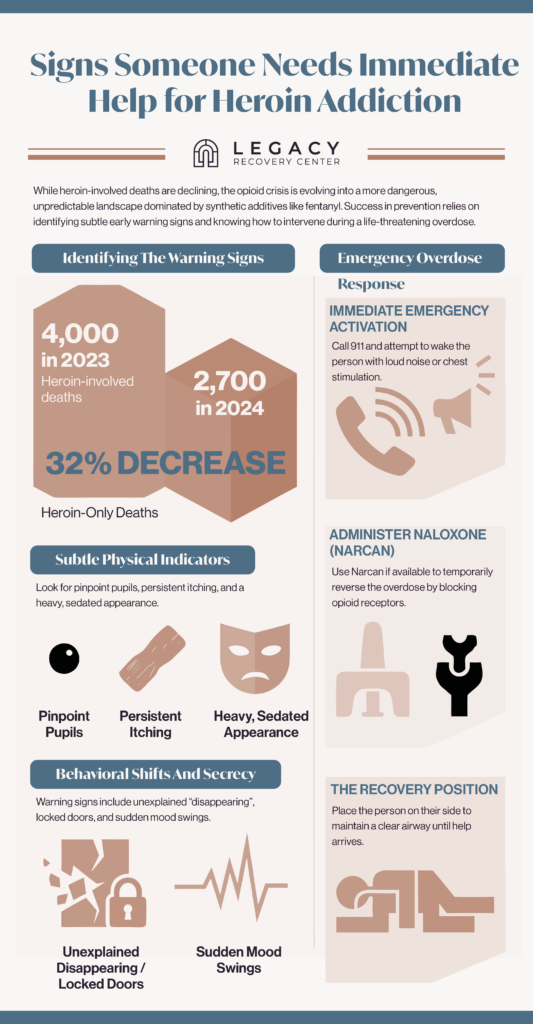
Many people expect heroin addiction to look obvious right away, such as nodding off, slurred speech, job loss, and dramatic “rock bottom” stuff. In reality, the early phase can be quiet. It often shows up as a slow shift in routine and personality.
Opioids can cause pinpoint pupils, itching, constipation, nausea, and a heavy, sedated look. Some people swing between being unusually sleepy and then agitated or edgy as the drug wears off. And because withdrawal feels awful (flu-like symptoms, anxiety, restlessness), people often return to using simply to feel normal, not just to get high.
Some common warning signs of heroin addiction may include:
- More secrecy than usual (locked doors, deleted texts, taking calls outside, hiding their phone)
- “Disappearing” in short bursts (frequent bathroom trips, going to the car, long walks for no clear reason)
- Mood shifts that don’t fit the situation (flat, numb, unusually calm → then irritable or anxious later)
- Nodding off at odd times or seeming sedated while claiming they’re “just tired”
- Pinpoint pupils (very small pupils) even in dim light
- Itching or constant scratching without a rash or allergy
Heroin and The Risk of Overdose
In the U.S., heroin-involved deaths dropped from about 4,000 in 2023 to roughly 2,700 in 2024. Many clinicians now describe heroin less as the primary driver of overdoses and more as part of a larger opioid environment where people may be exposed to other substances without realizing it [4].
Users may believe they are using heroin or another opioid without realizing the strength or contents have changed, increasing the likelihood of accidental overdose even among experienced users.
Recognizing an overdose quickly can save a life. Opioids slow the central nervous system, which can make breathing dangerously slow or stop altogether. A person experiencing an overdose may seem unusually sleepy at first, then become difficult or impossible to wake.
What to Do If You Suspect a Heroin Overdose
- Call 911 immediately. Even if you’re unsure, emergency responders would rather arrive early than too late.
- Try to wake the person. Call their name loudly, shake their shoulder, or rub your knuckles firmly on their chest.
- Give naloxone (Narcan) if available. Narcan is a medication that can temporarily reverse opioid overdoses by blocking opioid receptors. It is safe to use even if you’re not certain opioids are involved.
- Place them on their side in the recovery position to help keep the airway clear and reduce the risk of choking.
- Stay with them until help arrives. Narcan can wear off in 30–90 minutes, and overdose symptoms can return.
- If trained, give rescue breathing or CPR if the person is not breathing normally.
Integrated Drug & Alcohol Treatment in Arizona at Legacy Recovery Center
Legacy Recovery Center is a highly rated, premier addiction and mental health treatment center in Arizona. Legacy is owned and operated by two psychiatrists with over 40 years of combined experience, complemented by a robust therapeutic team.
We’re unique among residential treatment centers thanks to our ability to help people suffering from mental health and substance abuse issues. Our expert psychiatric team is equipped to treat multiple issues concurrently, focusing on your specific needs.
Sources
[1] Blanco, C. The changing opioid crisis: development, challenges and opportunities. Mol Psychiatry. 2021 Jan;26(1):218-233. doi: 10.1038/s41380-020-0661-4.
[2] National Institute of Drug Abuse. 2011. What are the immediate (short-term) effects of heroin use?
[3] George, T. The neurobiology of opioid dependence: implications for treatment. Sci Pract Perspect. 2002 Jul;1(1):13-20.
[4] CDC. 2025. Understanding the Opioid Overdose Epidemic.