







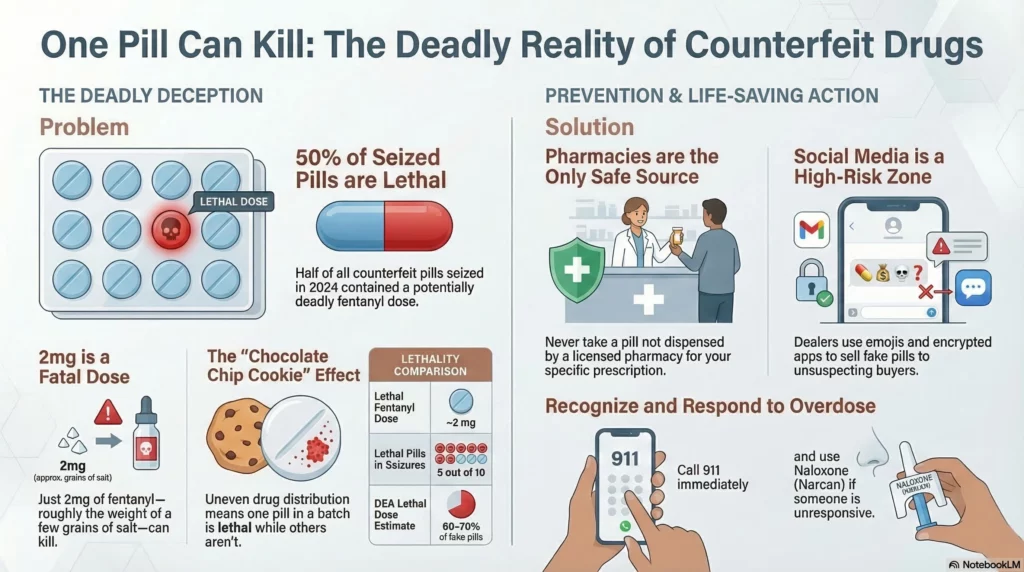
An alarming statistic from the U.S. Drug Enforcement Administration (DEA): five out of every ten counterfeit pills seized in 2024 contained a potentially deadly dose of fentanyl [1]. The internet and social media have made it easy for criminals to sell pills that look exactly like legitimate prescription medications.
The “One Pill Can Kill” crisis is not an exaggeration but a global public health emergency driven by the proliferation of fentanyl-laced counterfeits, preying on unsuspecting individuals [2].
The phrase “One pill can kill” means that a single counterfeit tablet bought outside the medical system can contain enough illicitly manufactured fentanyl (or similar drugs such as nitazenes) to cause a fatal overdose, even in someone with no opioid tolerance.
What Counterfeit Pills Are
Counterfeit pills are tablets made to look like legitimate medications (for example, Oxycodone, Xanax, Adderall), but pressed in illicit labs with no quality control. They are sold through street markets, friends, and increasingly via social media, the dark web, and encrypted apps.
Unlike substandard medicines that fail quality control, these are falsified products intentionally misrepresented to deceive consumers for financial gain. They often use the exact same markings, colors, and shapes as real products so that even experienced clinicians cannot reliably distinguish them by sight.
The Deadly Ingredients: It’s Not What You Think
Most counterfeit pills contain illegally manufactured fentanyl, a synthetic opioid 50 times more potent than heroin. by weight, so as little as about 2 mg can be enough to kill an average adult [3].
There is no quality control on the street. One pill might have a trace amount of fentanyl, while the next pill in the same batch could contain a dose high enough to stop a heart instantly.
The crisis is evolving. New synthetic drugs (like nitazenes) and adulterants such as the veterinary tranquilizer xylazine are increasingly found in counterfeit pills, complicating overdose response.
When traffickers mix fentanyl powder into pill presses, the drug is often unevenly distributed, meaning one tablet from a batch can contain a lethal dose while others contain much less. Current DEA testing indicates that the majority of fentanyl‑laced fake prescription pills seized—around 6–7 out of 10—contain a potentially lethal dose.
Who Is at Risk? (The “Innocent Victim” Problem)
The danger extends beyond those struggling with addiction. The Lancet Public Health notes that counterfeit pills have widened the scope to include adolescents experimenting with pills or tourists seeking medications abroad [4].
Many young people obtain these pills believing they are legitimate pharmaceuticals to help with focus, anxiety, or pain. Unknowingly, they are exposing themselves to the risk of fentanyl [5].
Scope of the crisis
Law enforcement seizures highlight the magnitude, having seized tens of millions of fentanyl‑containing counterfeit pills annually in the United States, along with large quantities of fentanyl powder. In late 2025, Colorado authorities discovered 1.7 million counterfeit fentanyl pills in a single storage unit—the largest seizure in state history.
Surveillance data show that overdose deaths involving evidence of counterfeit pill use more than doubled between 2019 and 2021, with especially steep increases in western states, and most of these deaths involve illicit fentanyl. Fortunately, there has been a 14.5% decrease in deaths between June 2023 and June 2024.
However, this counterfeit pill supply has expanded overdose risk into populations who may perceive pills as “safer than street drugs,” including adolescents and young adults experimenting or self‑treating pain, anxiety, or sleep problems.
How People Are Exposed
Counterfeit pills are widely marketed as “legit” painkillers, benzos, or ADHD meds through social media, messaging apps, and informal networks, often using emojis or coded language.
People may think they are taking a known dose of a known drug, when in reality they are ingesting fentanyl, fentanyl analogues, nitazenes, or combinations with illicit benzodiazepines that greatly increase the risk of respiratory depression.
Because the pills look real and are often shared between peers, many decedents had no intention to use opioids at all—what families often call “fentanyl poisoning” rather than traditional misuse.
Prevention and Harm Reduction
Public health and enforcement campaigns under the “One Pill Can Kill” banner focus on three core messages [4]:
- Never take pills that are not prescribed to you
- Assume any pill obtained outside a pharmacy could contain fentanyl
- Be wary of drugs offered via social media.
Telltale signs a drug may be fake:
- It came in odd packaging or quantities.
- It came from the Internet.
- It came from someone other than a medical professional.
Harm-reduction strategies include:
- Expanding naloxone (Narcan) access
- Teaching overdose recognition and response
- Promoting drug‑checking where legal
- Tailoring outreach to younger people and those who do not use traditional harm‑reduction services.
- If someone appears unresponsive after taking a pill—call 911 immediately.
A practical clinical message is:
- There is no way to “spot” a safe pill by appearance—the only reliably safe pills are those dispensed by a licensed pharmacy for a specific prescription.
Integrated Mental Health and Addiction Support at Legacy Recovery Center
Legacy Recovery Center is a highly rated, premier addiction and mental health treatment center in Arizona. Legacy is owned and operated by two psychiatrists with over 40 years of combined experience, as well as a robust therapeutic team.
We’re unique among residential treatment centers thanks to our ability to help people suffering from mental health and/or substance abuse issues. Our expert psychiatric team is equipped to treat multiple issues concurrently, focusing on your specific needs.
Sources
[1] Drug Enforcement Agency. 2024. Overdose Deaths Decline, Fentanyl Threat Looms.
[2] O’Donnell J, et al. Drug Overdose Deaths with Evidence of Counterfeit Pill Use — United States, July 2019–December 2021. MMWR Morb Mortal Wkly Rep 2023;72:949–956.
[3] National Institute on Drug Abuse. 2025. Fentanyl.
[4] Friedman J, Ciccarone D. The public health risks of counterfeit pills. Lancet Public Health. 2025 Jan;10(1):e58-e62.
[5] Counterfeit Prescription Drugs Are Killing Our Kids in Record Numbers. onepillkilled.org